Five Questions with Math, Physics, and Biology Student Rehan Adatia
Feb. 24, 2026
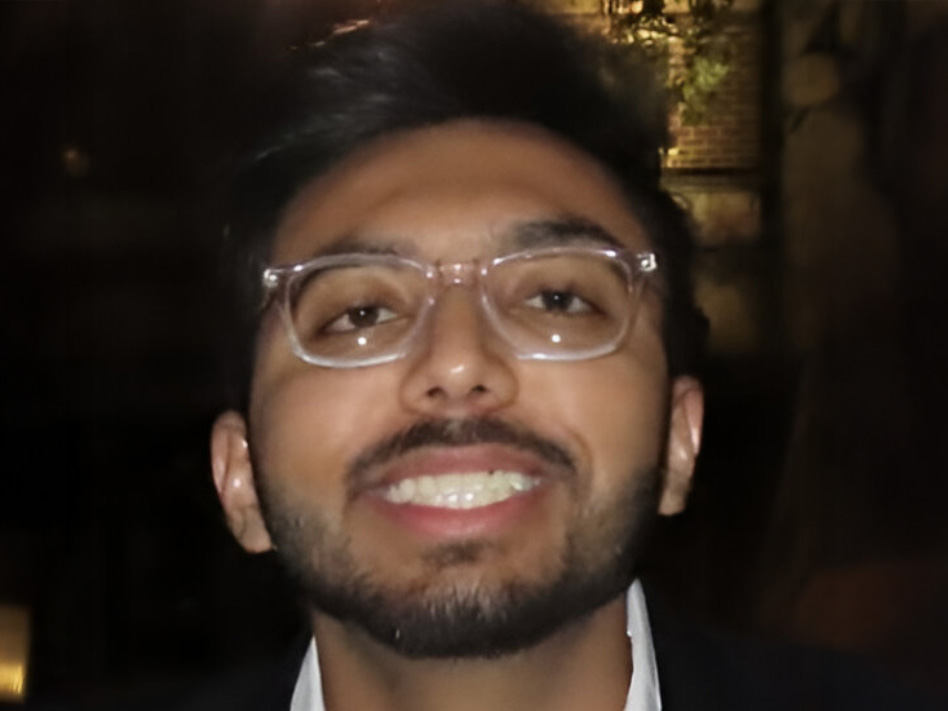
Rehan Adatia’s undergraduate career is defined by his drive to understand a broad range of sciences offered by the College. An ambitious triple major, Adatia’s time spent in the Department of Mathematics and Applied Mathematics, the Department of Physics, and the School of Life Sciences and Sustainability is preparing his pursuit to go to medical school after graduation.
Why did you choose your major?
I chose physics because I wanted to study a subject that I found genuinely challenging and that helped me understand how the universe works. I chose mathematics because I enjoyed the way it forced me to think carefully and build knowledge in other fields on a solid foundation. I chose biology because I find it fascinating how many interacting parts come together to form the system we call life.
 Favorite class so far? Why?
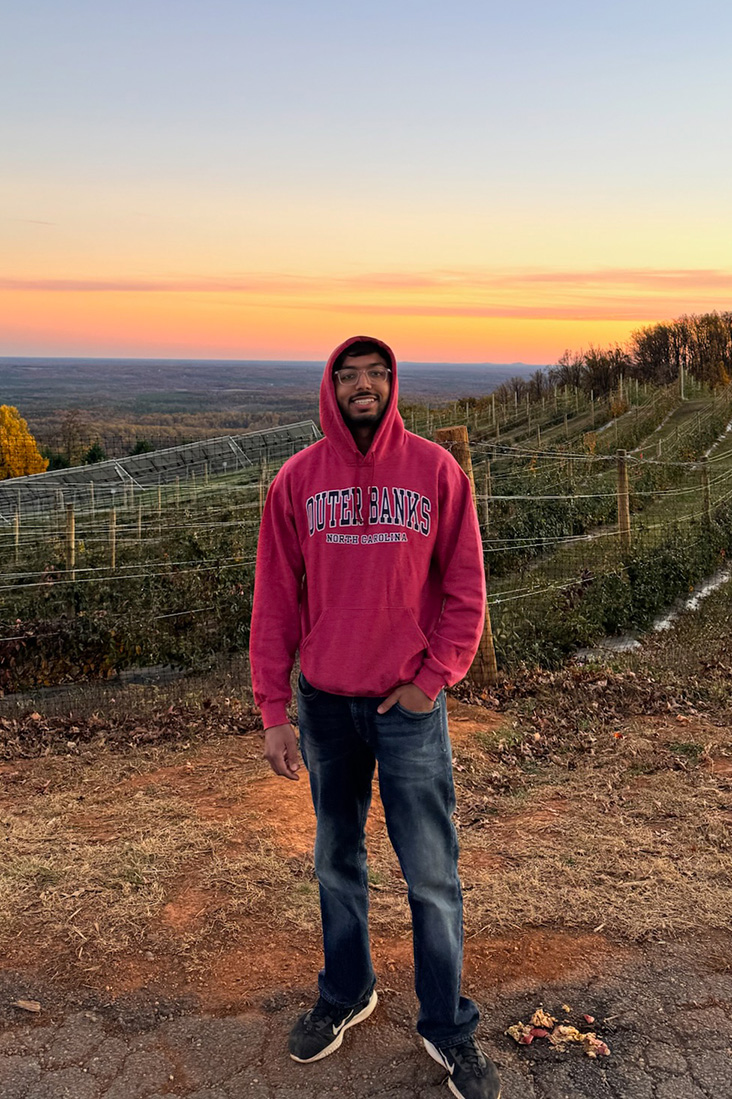
My favorite class has been PHYS 340: Statistical Mechanics and Thermodynamics. At the start, the course felt unusually abstract and very different from the physics classes I had taken before. Unlike most of my prior coursework, it was largely conceptual, with relatively little mathematics needed to follow the ideas. I found that shift surprisingly enjoyable.
My favorite moments came around the middle of the semester, when the material began to come together. I started noticing connections between what we were learning and concepts I had encountered in my chemistry courses, such as the Pauli Exclusion Principle. Seeing those links form across subjects led to several “aha” moments. I remember asking Jason Reed, Ph.D., whether a concept in class matched something I had seen before, and he would smile and say, “Exactly.”
Favorite professor so far? Why?
 My favorite professor is Ihsan Topaloglu, Ph.D., in the Department of Mathematics and Applied Mathematics. I have taken three classes with him and have also worked with him on a research project. He has been consistently supportive and has a strong ability to make difficult material approachable. His depth of knowledge is clear, and his enthusiasm for the subject makes his classes engaging. He also goes beyond mathematics, often discussing historical context, which adds meaning and makes the material more interesting.
Most interesting thing in your major's curriculum that you've learned or experience you've had?
Across my undergraduate studies, what I have found most interesting is how limited our understanding of the world still is. In quantum mechanics, many of the underlying processes remain fundamentally uncertain. At the other extreme, when studying cosmology and the large-scale structure of the universe, our intuitive understanding again breaks down. We tend to understand physical phenomena best at the scales we directly experience, yet even within those regimes, many questions remain unresolved. There is far more about the world than we understand right now, and most of it will remain beyond our understanding altogether.
 What are you hoping to do after graduation? Why?
I want to go to medical school because I am motivated by where scientific understanding directly impacts people during vulnerable moments. That interest became concrete for me as an emergency medical technician (EMT), where I helped patients during emergencies but I also became aware of the limits of my role once care was handed off. While I valued being present in moments of crisis, I wanted to understand what came next, including diagnosis, treatment and recovery. Medicine offers that continuity, bringing together my curiosity about how the body works with the responsibility of guiding patients through suffering in a sustained and meaningful way.